Showing posts with label guide. Show all posts

Sunday, 6 September 2015

Most Powerful Motorcycle

The Japanese motorcycle manufacturer Kawasaki recently introduced what it calls the most powerful closed-course production motorcycle ever created, the Kawasaki Ninja H2R. The new bike takes its name from the 1971 Kawasaki 750SS Mach IV, more commonly known as the H2, which by many accounts was the fastest motorcycle of its day. Continuing this tradition, the H2R will be equipped with an approximately 300 hp inline 4-cylinder supercharged engine, the most powerful on the market.


The H2R engine is a 998 cc inline-4, four-valve, dual overhead cam design with a two-speed, centrifigual supercharger claimed by Kawasaki to develop 300 horsepower (220 kW). The supercharger is driven by a series of gears and shafts connecting the flywheel to a planetary drive, finally spinning a dog-shifted two-speed shaft attached to the impeller.Rider control is throttle by wire.

It is the first production motorcycle with a supercharger,although turbochargers were available on some models in the early 1980s.
A centrifugal supercharger has the advantage of generating less heat than other designs, especially scroll-type or screw-type superchargers. Excess heat in the intake charge can cause pre-ignition that will destroy the engine
.


The front fairing of the Ninja H2R features said to look like wings, made of carbon fiber like the rest of the bodywork. They may be aerodynamic devices designed to create a low-pressure zone to help move cooling air through the engine bay, or to produce downforce at high speed, or to provide straight-line stability in a short-wheelbase sportbike chassis.

Scooters

Scooter engine sizes range smaller than motorcycles, 50–850 cc (3.1–51.9 cu in), and have all-enclosing bodywork that makes them cleaner and quieter than motorcycles, as well as having more built-in storage space. Automatic clutches and continuously variable transmissions (CVT) make them easier to learn and to ride. Scooters usually have smaller wheels than motorcycles. Scooters usually have the engine as part of the swingarm, so that their engines travel up and down with the suspension.


Touring

Although any motorcycle can be equipped and used for touring, touring motorcycles are specifically designed to excel at covering long distances. They have large-displacement engines, fairings and screens that offer good weather and wind protection, large-capacity fuel tanks for long ranges between fill-ups, and a relaxed, upright seating position. Passenger accommodation is excellent and expansive luggage space is the norm for this class. Such bikes can have wet weights of 850–900 lb (390–410 kg) and top 1,300–1,400 lb (590–640 kg) fully loaded with a rider, passenger and gear.


Bagger, full dresser, full dress tourer, or dresser are various names for touring motorcycles, sometimes used disparagingly or jocularly, and originally referring to a Harley-Davidson or other cruisers with full sets of saddlebags. Now refers to any touring motorcycle.

Sport Bikes

Sport bikes emphasize speed, acceleration, braking, and cornering on paved roads, typically at the expense of comfort and fuel economy in comparison to less specialized motorcycles. Because of this, there are certain design elements that most motorcycles of this type will share. Sport bikes have comparatively high performance engines resting inside a lightweight frame.


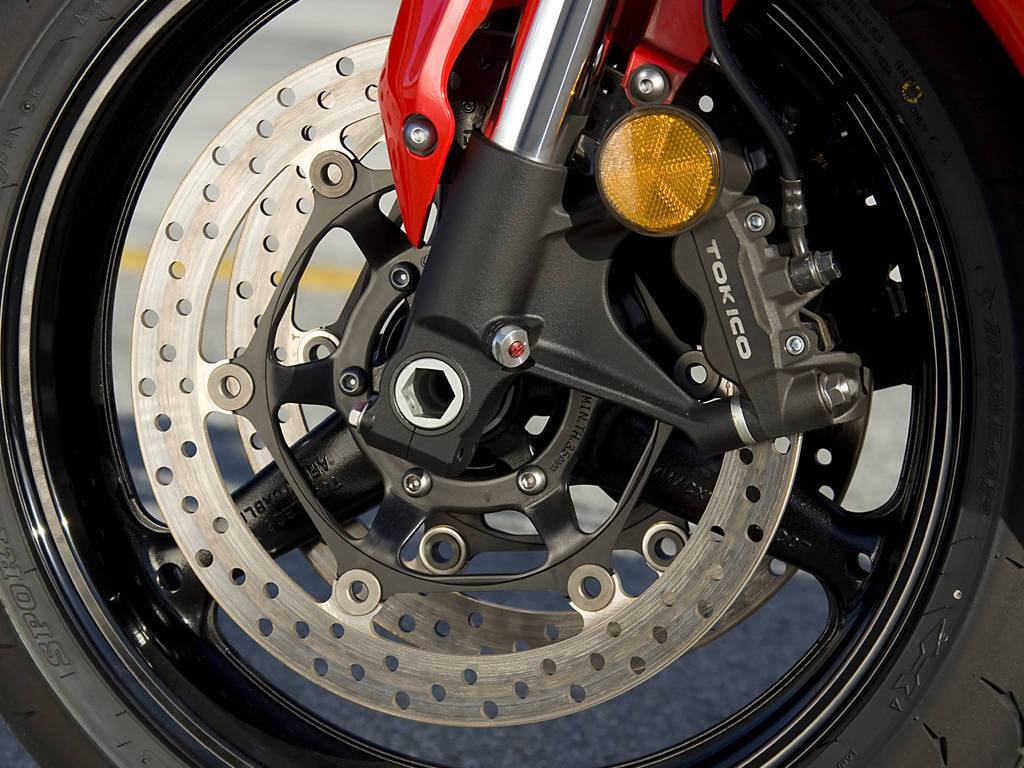
Inline-four engines dominate the sport bike category, with V-twins having a significant presence, and nearly every other engine configuration appearing in small numbers at one time or another. The combination of these elements helps maintain structural integrity and chassis rigidity. Braking systems combine higher performance brake pads and multi-piston calipers that clamp onto oversized vented rotors. Suspension systems are advanced in terms of adjustments and materials for increased stability and durability. Most sport bikes have fairings, often completely enclosing the engine, and windscreens that effectively deflect the air at very high speeds, or at least reduce overall drag.


Sport bikes have high footpegs that position the legs closer to the body to improve ground clearance when cornering, and a long reach to the hand controls, which positions the body and center of gravity forward, above the fuel tank. The rider leans forward into the wind, the force of which can comfortably support the rider's weight at speeds near 100 mph (160 km/h), but at lower speeds leaves too much weight on the arms and wrists, causing fatigue.


Streetfighters are derived from sport bikes, originally being customized sport bikes with the fairings removed and higher handlebars replacing the low clip-on handlebars. Since the 1990s, factory streetfighters have been produced. As with naked bike and muscle bike (below), the name streetfighter is used to help clarify the middle ground occupied by designs that blend elements of both sport bikes and standards.

Cruiser Bikes

Cruisers are styled after American machines from the 1930s to the early 1960s, such as those made by Harley-Davidson, Indian, and Excelsior-Henderson. Harley-Davidsons largely define the cruiser category, and large-displacement V-twin engines are the norm, although other engine configurations and small to medium displacements also exist. Their engines are tuned for low-end torque, making them less demanding to ride because it is not necessary to shift as frequently to accelerate or maintain control. Cruisers are sometimes called "custom" even in the absence of aftermarket modifications.


The riding position places the feet forward and the hands are up relatively high, so that the spine is erect or leaning back slightly. At low to moderate speeds, cruisers are more comfortable than other styles, but riding for long periods at freeway speeds can lead to fatigue from pulling back on the handlebars to resist the force of the wind against the rider's chest. Cruisers have limited cornering ability due to a lack of ground clearance.

Choppers are a type of cruiser, so called because they are a "chopped", or cut-down, version of a production cruiser. Choppers are usually custom projects that result in a bike modified to suit the owner's ideals, and, as such, are a source of pride and accomplishment. Stereotypically, a chopper may have raked-out forks, small fuel tanks and high handlebars. Choppers were popularised in the Peter Fonda film Easy Rider. Being designed primarily for visual effect, choppers will not usually be the most efficient riding machines.

Power cruiser is a name used to distinguish bikes in the cruiser class that have significantly more engine output, around 80–100 hp (60–75 kW) as opposed to about 50–70 hp (37–52 kW). They often come with upgraded brakes and suspensions, better ground clearance, and premium surface finishes, as well as more exotic or non-traditional styling.

Naked Bikes

A standard or naked motorcycle is one combining an upright riding position, handlebar and footpegs positioned for comfort, and usually but not always without fairing or windscreen.
Also called  roadsters are versatile, general purpose street motorcycles.They are recognized primarily by their upright riding position, partway between the reclining rider posture of the cruisers and the forward leaning sport bikes. Footpegs are below the rider and handlebars are high enough to not force the rider to reach far forward, placing the shoulders above the hips in a natural position. Because of their flexibility, lower costs and their engines of moderate output, standards are particularly suited to motorcycle beginners


Standards usually do not come with fairings or windscreens, or if they have them, they are relatively small. Standard is often a synonym for naked bike, a term that became popular in the 1990s in response to the proliferation of fully faired sport bikes. The standard seemed to have disappeared, fueling nostalgia for the return of the Universal Japanese motorcycle (UJM),which were admired for their simplicity, quality, and versatility.
Muscle bike is a nickname for a motorcycle type, derived from either a standard or sport bike design, that puts a disproportionately high priority on engine power. Roadster is an older term, equivalent to standard or naked.

History of Motorcycles

Motorcycle history begins in the second half of the 19th century. Motorcycles are descended from the "safety bicycle," a bicycle with front and rear wheels of the same size and a pedal crank mechanism to drive the rear wheel.
Despite some early landmarks in its development, motorcycles lack a rigid pedigree that can be traced back to a single idea or machine. Instead, the idea seems to have occurred to numerous engineers and inventors around Europe at around the same time.

In the early period of motorcycle history, many producers of bicycles adapted their designs to accommodate the new internal combustion engine. As the engines became more powerful and designs outgrew the bicycle origins, the number of motorcycle producers increased. Many of the nineteenth century inventors who worked on early motorcycles often moved on to other inventions. 

A 1913 FN (Fabrique National), Belgium, 4cylinders and shaft drive
In 1901 English quadricycle and bicycle maker Royal Enfield introduced its first motorcycle, with a 239 cc engine mounted in the front and driving the rear wheel through a belt. In 1898, English bicycle maker Triumph decided to extend its focus to include motorcycles, and by 1902, the company had produced its first motorcycle—a bicycle fitted with a Belgian-built engine.
A year later, it was the largest motorcycle manufacturer with an annual production of over 500 units. Other British firms were Norton and Birmingham Small Arms Company who began motorbike production in 1902 and 1910, respectively.
Triumph Motorcycles Model H
In 1901, the Indian Motocycle Manufacturing Company, which had been founded by two former bicycle racers, designed the so-called "diamond framed" Indian Single, whose engine was built by the Aurora Firm in Illinois per Indian's specifications. The Single was made available in the deep blue. Indian's production was up to over 500 bikes by 1902, and would rise to 32,000, its best ever, in 1913. Producing over 20,000 bikes per year. The American company Harley-Davidson started producing motorcycles in 1903.
Triumph Bonneville 

By 1920, Harley-Davidson was the largest manufacturer, with their motorcycles being sold by dealers in 67 countries. By the late 1920s or early 1930s, DKW in Germany took over as the largest manufacturer.BMW motorcycles came on the scene in 1923 with a shaft drive and an opposed-twin or "boxer" engine enclosed with the transmission in a single aluminum housing.


By 1931, Indian and Harley-Davidson were the only two American manufacturers producing commercial motorcycles.This two-company rivalry in the United States remained until 1953, when the Indian Motorcycle factory in Springfield, Massachusetts closed and Royal Enfield took over the Indian name 

Honda CB750
From the 1960s through the 1990s, small two-stroke motorcycles were popular worldwide, partly as a result of the pioneering work of the East German Daniel Zimmermann (rotary disc valve) and MZ's Walter Kaaden who developed the two-stroke expansion chamber in the 1950s. These ideas were taken up by Suzuki when Ernst Degner, the MZ engineer and rider, defected to the West on 13 September 1961 after retiring from the 125cc Swedish Grand Prix at Kristianstad. Degner, an excellent engineer, immediately joined Suzuki and his knowledge became their technology springboard.

Today the Japanese manufacturers, Honda, Kawasaki, Suzuki, and Yamaha dominate the large motorcycle industry, although Harley-Davidson still maintains a high degree of popularity, particularly in the United States
.


Recent years have seen a resurgence in the popularity around the world of many other motorcycle brands, including BMW, Triumph and Ducati, and the emergence of Victory as a second successful mass-builder of big-twin American cruisers. 
Other manufacturers, including Royal Enfield, had been producing diesel-powered bikes since at least 1965.


Since the year 2000 it really does appear that almost every manufacturer is getting the style, choice, comfort, price and performance mix right! This has truely never happened before in this industry.

Friday, 4 September 2015

Fluel Efficient Motorbikes In 2015


Followings are considered as most efficient motorbikes in 2015

2015 Yamaha Sr400 @60MPG

2015 Honda Grom 125 @99MPG


2015 Honda CTX700 @64MPG


Kawasaki KLX250 @70MPG

Royal Enfield EFi @70MPG

Suzuki DL650 V-Storm @65MPG


Yamaha FZS600 @45MPG


Beginners Guide: Riding A Motorcycle


Riding a motorcycle is much more complex than driving a car. A rider must be very carefull to their surroundings and must have a level of physical coordination that is not required by a car. That being said, riding is a very enjoyable and adventurous experience that I hope more people will discover. You will discover a sense of freedom when riding a motorcycle that a car, even a convertible, cannot offer. If you have ever ridden a jet ski, a motorcycle is almost like a jet ski on land.

These instructions aim to give you a step by step guide on how to ride a motorcycle. While riding a motorcycle is a skill that is continually developed and takes months to years to master, this instructable should have you familiar with a motorcycle in about an hour or two.

I also recommend that you learn to ride in a safe and open area such as a isolated roads or country side roads. Don't take to the roads or highways until you have gotten license.


1.Gear Up with quality


Riding a motorcycle can be extremely dangerous. When on a motorcycle you are completely unprotected, you aren't surrounded by a steel cage or air bags. Failure to wear proper safety equipment can result in extreme personal injury and death.

You should drive motorcyle wearing following safty equipment:
1.Helmet
2.Gloves
3.Boots
4.Jacket
5.Pants

No matter what your age or level of experience, whenever you ride a bike, in-line skate, ski, or engage in other activities during which your head is vulnerable to injury, a helmet should be worn. In fact, many states now have laws that require helmet use.

Wearing a bike helmet reduces the risk of serious head and brain injury by 85%. Helmets should be worn during every ride, no matter how short. Many accidents happen near home.
Children younger than 12 years should also wear helmets when sledding.

Motorcycle jackets differ from regular jackets as they are padded to protect against impact and abrasion. A typical leather jacket will provide fair abrasion resistance, but without any pads or cushions your body will feel the full force of the impact should you crash. Motorcycle jackets will have pads (armor) in the back/spine, shoulders, elbows, and forearms. Quality jackets will have CE certified armor.

Motorcycle jackets fall under three categories, leather, textile, and mesh.

Leather jackets offer the most protection from abrasion but are typically the hottest and least comfortable.
Mesh jackets offer the least protection, are the coolest, and often the most comfortable.
Textile jackets fall in between.

What jacket to wear depends on your riding style, personal preference, and the weather conditions of your area. Often times jackets will be a combination, with some textile or leather parts and some mesh or perforated parts.

2.Know Your Motorcycle


Motorcycles have the following controls:
Clutch Lever - Engages/disengages power from the rear wheel.
Gear Shifter - Shifts between gears, moving 1 gear up or 1 gear down at a time.
High/Low Beam Switch - Toggles the high-beam headlight.
Hazard Lights - Toggles the hazard lights/flashers.
Turn Signals - Toggles the left and right turn signals.
Horn - Sounds the horn.
Front Brake Lever - Controls the front brake.
Rear Brake Pedal - Controls the rear brake.
Throttle - Controls the throttle.
Engine Kill Switch - Cuts the engine off. Useful for emergencies.
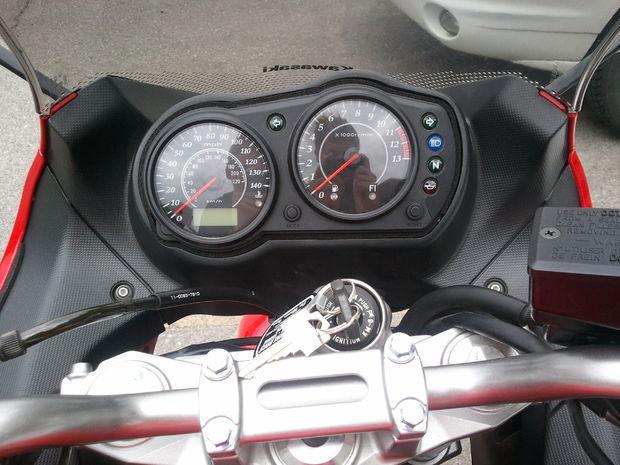
Ignition Switch - Starts the motorcycle.
Kick Stand - Holds the bike up when not being ridden.

The left side of the motorcycle is to control gears. The right side of the motorcycle is to control acceleration and braking.

The best way to gain an understanding of the controls is to sit on the motorcycle and try them out. Getting on a motorcycle is easiest if done from the left side as it is then leaning towards you. When you are sitting on a motorcycle you should straddle the low point of the gas tank.

1. Face the motorcycle from the left side.
2. Swing your right leg over the seat.
3. Plant both feet firmly on the ground.
4. Pull in the front brake to help stabilize the motorcycle.
5. Pull the motorcycle off its kickstand.
6. Sit down on the seat.
7. Put the key into the ignition and turn it to the on position.
         .
8. Inspect the handlebars and the foot pegs, make sure everything is within reach.
        
9. Without starting the motorcycle, locate, identify and operate every component in the pictures on your motorcycle until you are comfortable with their location and use.

3.Start it


 1. Flip the engine kill-switch to the 'on' position.
         Note: The symbol for the 'on' position will be a circle with a small cutout without an X over it.
2. Kick the kickstand up with your left foot.
3. Press and hold the ignition switch.
         Note: If your motorcycle is carbureted, you may need to adjust the choke and give it extra gas when starting.
         Note: Some motorcycles require you to pull in the clutch when starting, even when in neutral.
4. Release the ignition switch once the motorcycle has started.

4.Practice Turning
Now that you are comfortable with where the motorcycle starts to move you should now practice turning. Motorcycles turn much differently when they are moving slowly than when they are moving quickly. Under 10 miles per hour (or so) motorcycles use conventional turning. If you want to go right you turn the handlebars right, if you want to go left you turn the handlebars left. A trick to turning with motorcycles is to always look through your turn. That means that you are looking at where you want to go the entire time you are turning, not in front of you. Again, the motorcycle wants to go where your head is looking.

5.Accelerating And Deaccelerating.


One of the joys of a motorcycle is that the only difficult gear is first. Once the bike is moving shifting is much easier. When to shift is entirely dependent on your motorcycle, your riding situation, and your riding style. Generally speaking, a sportier riding style favors shifting later, while a fuel efficient style favors shifting earlier.

A rough idea of the gear to be in is:
0-15 MPH - 1st
15 - 30 MPH - 2nd
30 - 45 MPH - 3rd
45 - 55 MPH - 4th
55 - 65 MPH - 5th
65+ MPH - 6th

Emphasis on rough idea. A 1000cc sport bike could go 70 MPH in 2nd gear if you wanted to (not that I'd recommend that).

While accelerating, when you feel like you want to up shift there is a procedure:
1. Pull in the clutch and release the throttle.
2. Kick the gear shifter up and return to the original position.
3. Roll on the throttle as you release the clutch.

When you need to decelerate on a motorcycle there is one key thing to remember, the vast majority (70% or more) of your stopping power comes from your front brake. When you want to decelerate there are two main ways, engine braking and conventional braking.

Engine braking is using the natural resistance of the engine to slow the motorcycle. This is done by releasing the clutch and allowing the engine's RPM to drop and by potentially downshifting. Be sure not to stall the motorcycle when doing this.

Conventional braking is simply using the disc brakes like on a car. Simply pull the front brake and press the rear brake simultaneously.

If you feel that you have slowed down enough that you should downshift, the procedure is very similar to up shifting.
1. Pull in the clutch and release the throttle.
2. Kick the gear shifter down and return it to its original position.
3. Roll on the throttle as you release the clutch.

If you are coming to a complete stop, be sure to pull the clutch in so you do not stall the bike. When you are about to stop moving, place your left foot on the ground (the right foot should still be braking). Once you come to a stop, place your right foot on the ground as well.

If while braking you lock up a tire and it starts skidding, what you do depends on the tire. If it is the rear tire, your best bet is to keep the tire locked until you are moving in a straight line again or stopped. If you release the rear brake while skidding or drifting it can cause the rear of the bike to essentially snap back into place which can cause you to fly off the bike. If you lock the front brake immediately release it and slowly reapply it. Locking the front brake can be dangerous as you can be sent over the handlebars or the front wheel my cut (sharply turn to one side).

6.Breaking And Stopping.
This information was originally published in the New Zealand Motorcycle Safety Consultants  Megarider eNewsletter.

The front brake is the most effective, giving between 60 & 80% of the bike's stopping power in hard stops, depending upon surface conditions. This is because most of the weight of the bike and rider transfers forward onto the front wheel when the brakes are applied.

A common example of weight transfer is when you trip on a gutter - your feet stop but momentum keeps the top of you going and you fall flat on your face. The weight transfer that takes place under braking on a motorcycle pushes the front wheel onto the ground and makes it grip very well.The front wheel is likely to skid uncontrollably and bring you down only if you jam the front brake on hard. If you apply the front brake in a staged (progressive) process, the front wheel may skid but that skid is normally quite controllable.